Fall has arrived in Wyoming, and with it comes that familiar shift in the air — colder mornings, earlier sunsets, and the quiet reminder that nothing stays the same for long. Seasons change, and so do we. Sometimes gently, sometimes abruptly, sometimes in ways we didn’t choose.
This month, I’ve been reflecting on the ideas in From Strength to Strength since I’ve been leaning into the book for a team facilitation— the invitation to move from our first curve into our second curve, from achievement into wisdom, from striving into purpose. It’s a transition that mirrors the season: a letting go, a turning inward, a readiness for what’s next.
And for many of us, “what’s next” feels very real right now.
Life Right Now: The Real Second Curve
The second curve isn’t theoretical. It shows up in the messy, beautiful, complicated places of our actual lives.
For me, it looks like this:
A body that demands gentleness.
Autoimmune challenges have a way of forcing clarity. They ask you to slow down, to listen, to stop pretending you’re invincible. My first‑curve strength was powering through. My second‑curve strength is honoring limits without losing momentum.
A senior year that feels like a countdown.
The last kid’s senior year is a season of nostalgia, pride, and tiny heartbreaks. It’s the quiet realization that the house will change, the routines will shift, and the role of “mom” evolves yet again. My first‑curve strength was managing everything. My second‑curve strength is savoring what’s left and releasing what’s next.
A marriage entering a new chapter.
Long marriages don’t stay static. They stretch, contract, renegotiate, and reinvent. With kids leaving, careers shifting, and life speeding up, the dynamics change. My first‑curve strength was partnership through logistics. My second‑curve strength is partnership through intention.
A career that’s expanding in unexpected ways.
Policy work, coaching, leadership development — all of it is evolving. My first‑curve strength was expertise. My second‑curve strength is influence rooted in wisdom, clarity, and service, and I must say…it feels good.
This is what the second curve looks like in real life: Not reinvention for reinvention’s sake, but a deeper, more grounded version of who we’ve always been.
Refocusing Our Strengths — Turning Them Into Powers for Good
From Strength to Strength teaches that our greatest impact comes when we use our strengths not to prove ourselves, but to serve others. And that sounds beautiful — but it’s also real work. Especially when life is heavy, complicated, or stretching us in ways we didn’t expect.
Here’s how that’s showing up right now:
My analytical mind → becomes clarity for others.
Even when the policy landscape is noisy, political, or emotionally charged, I’m offering steadiness and truth for my consulting clients. That’s a power for good.
My coaching identity → becomes a catalyst for reinvention.
I’m helping clients navigate transitions, identity shifts, and energy patterns — even while I’m navigating my own. That’s a power for good.
My leadership voice → becomes a bridge.
I’m creating alignment in rooms where tension, urgency, and competing priorities could easily take over. That’s a power for good.
My personal resilience → becomes grace in motion.
I’m moving through autoimmune challenges, house construction chaos, senior‑year emotions, and evolving marriage dynamics — and still showing up with humor, compassion, and presence. That’s a power for good.
And yet… sometimes grace is hard.
There are days when the body hurts, when the house feels too loud, when the senior‑year countdown feels too fast, and when marriage requires renegotiation instead of routine. There are moments when grace feels like something you reach for, not something that flows naturally. And it’s hard. Patience is thin. When emotions sit too close to the surface. When the second curve feels less like a calling and more like a cliff. But even then — especially then — your strength is in the returning.
The softening.
The choosing again (in the mindfulness space, we say, “simply, begin again.”)
The willingness to keep showing up with intention, even when grace doesn’t come easily.
That, too, is a power for good.
Three Questions for Your Second Curve
Use these as journal prompts or quiet reflections:
Which of my strengths are ready to evolve with the season I’m in?
Where am I being invited to shift from achievement to wisdom?
How can I use my strengths this month as powers for good, not just tools for performance?
A Quote for This Season
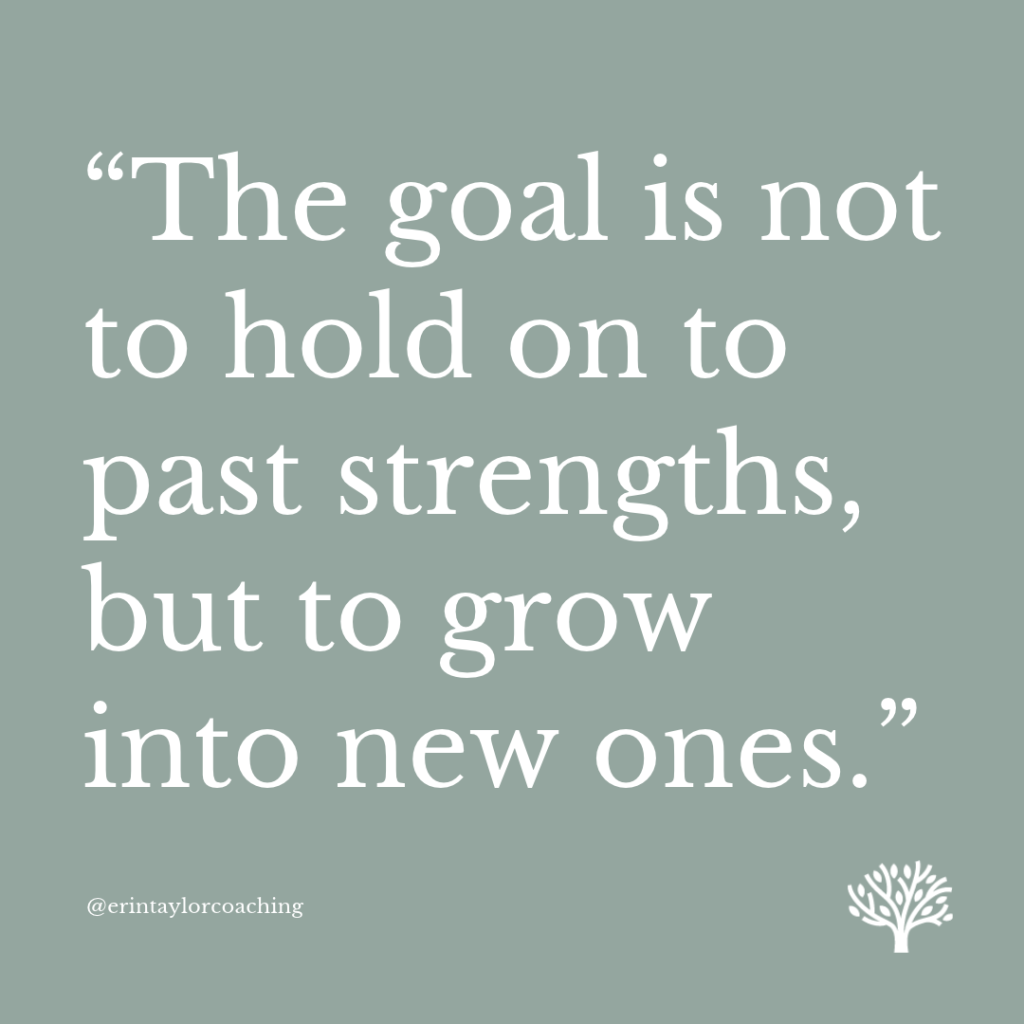
Fall teaches us this every year: Let go. Turn inward. Prepare for what’s next.
Closing Encouragement
You are in a season of profound transition — physically, emotionally, professionally, and personally. None of it is accidental. All of it is shaping you for your second curve. Pay attention.
Your strengths are not fading. They’re transforming. And the next chapter isn’t about doing more. It’s about doing good, better.
Here’s to stepping into this season — and your second curve — with courage, clarity, and a deep sense of purpose.